| Welcome, Guest |
You have to register before you can post on our site.
|
| Online Users |
There are currently 34 online users.
» 1 Member(s) | 32 Guest(s)
Applebot, GregoryCoack
|
|
|
| Scerpian Vine |
|
Posted by: __denby - 01-19-2025, 06:14 PM - Forum: Flora
- No Replies
|
 |
Scerpian Vine
“Oh Snail! Climb Mount Fuji; but slowly, slowly.” - Kobayashi Issa
.
Summary:
A vine of immense strength, the Scerpian Vine acquires its name by the nature in which it seems to writhe and cling to the ground, in addition to its hard scale-like bark which covers the entirety of the mature vine, from root to flowering upper canopy. It has developed over time to be one of the hardiest and most difficult plants to rid oneself of, despite its relatively slow growth. Possessing a very dense barklike outer layer, it is flexible and resistant to chopping or slicing; while the interior of the vine is a tightly-woven network of stringy fibers that bind and often resist the blade of a saw with intense resolve. Anything short of a high-strength steel tool is unlikely to cut the vines without sustaining significant damage to themselves.
Basic Description:
Growing to incredible lengths through interconnected root networks, the Scerpian Vine is a menace, clambering across whatever lies in its path as though it were a mere assistance towards its eternal goal of acquiring more sunlight and soft soil. Possessing broad clover-like leaves that adorn the upper portions of the heavy vines, it is the nature of the vines to creep and spill wherever they may in order to absorb as much sunlight as possible. Vines closer to the ground tend to be heavier, thicker and of a stronger wood-like texture. When growing in clusters large enough, the vines nearest the center of the cluster tend to adopt a tree-like structure, often sinking a primary root ball, the vines at the core being more akin to branches than looser vines. At times, the Scerpian Vine forms nigh-impassable walls within their habitats, choking out other flora and fauna to such a degree that in some cases, the largest Scerpian clusters are essentially forbidding wastelands.
Rarity: Rare
Location:
Scerpian Vines tend to be found in low-lying areas, where moisture and humidity collect in large volumes, such as the floors of jungle canopies, wet coniferous forests and swampy lowlands. It is not found often, but where it is, it is growing in enormous clusters, typically consuming whatever structures, trees and rocks as it proceeds ever-onwards as a veritable force of nature.
Properties:
The Scerpian Vine grows slowly, but plods ever-onwards as a force of nature. It takes quite a lot of work to rid an area of the menace.
Possessing dense, flexible, wood-like bark, the plant is difficult to burn, and equally difficult to cut with anything but a hardened steel saw.
The interior of the Scerpian Vine is a dense and fibrous material, resisting to-and-fro cutting actions, typically having to be grasped by both ends and chopped through. The fibers can be equated to the strength of tightly-woven silk.
Special Properties:
Barring the relative strength of the Scerpian Vine, it possesses no known medicinal or alchemical properties.
The interior fibers of the vine are highly conducive to capillary flow.
|

|
|
| Alabaster Moss |
|
Posted by: __denby - 01-19-2025, 06:09 PM - Forum: Flora
- No Replies
|
|
Alabaster Moss
“The dog that trots about, finds a bone.” - Golda Meir
.
Summary:
Marring the landscape as a cruel bone-white scar, Alabaster Moss evokes a sense of otherworldly eeriness, a veritable tombstone to what was lost in the ancient past. Most often seen on ancient battlefields, the moss clings close to the ground, sprawling across the earth in a spider-like fashion; small and bulbous clumps of the growth standing no higher than six inches. Narrow reddish floral bodies poke sparsely from within the moss, giving it the faintest fleck of color amidst an otherwise blank sea of off-white.
As legend tells, the Alabaster Moss came about as a representation of the divine’s sorrow towards mortalkind; wars and conflicts spilling the blood of men and beast, piecemeal demolishing nature for the furtherment of the engines of war. This despair led to the birth of a marker, a tombstone provided by no man, and only set upon the realm by the extension of life herself. An alabaster color, prostrated eternally upon the ground where countless men fell, the moss serves as a gravemarker, to last till the very earth forgets the presence of those who died, and their bodies are all but a faded memory. It only grows in places of great loss, where the bodies of man and horse had piled high, and the ground was stained crimson by the ever-full coffers of war.
Basic Description:
Alabaster Moss is a low-lying ground shrub which takes the appearance of a lichen-like substance, possessing many spindly and bulbous branches that trail from the central stalk. Being an eerie bonelike color and harboring many small internal pockets, the best approximation to the Alabaster Moss is a surface-dwelling coral. Much akin to coral, the plant grows and branches in varied directions, lacking entirely in leaves, and instead being covered in thin, hairlike protuberances.
Rarity: Rare
Location:
Alabaster Moss is only known to grow in locations where battles, mass graves, and other horrific events have occurred. This is naturally due to the high concentration of calcium, iron and other nutrients that have found their way into the earth due to the volume of decomposites. It would be possible to grow the plant elsewhere, so long as the environment possesses an exceedingly high concentration of such elements.
Properties:
Spiny and lacking entirely in leaves, the plant is most similar to a coral.
It possesses very little in terms of nutrients, and animals tend to not eat it.
Alabaster Moss grows only in locations rich in decomposites, such as mass graves and battlefields.
Special Properties:
The hollows and pockets within the stalks of the Alabaster Moss contain relatively high concentrations of elemental oxygen and sodium, and is quite flammable.
|
|
|
|
| Creamgrass |
|
Posted by: __denby - 01-19-2025, 06:04 PM - Forum: Flora
- No Replies
|
|
Creamgrass
“Ask not what you can do for your country. Ask what’s for lunch.” - Orson Welles
.
Summary:
A rapidly-growing and rather hardy plant, Creamgrass mirrors most attributes of dense field grasses, bearing lengthy seed bundles atop the rather dense brush-growth below. Formed of a very fibrous and hollow reed-like stalk, Creamgrass retains a very viscous sap-like liquid within the hollow stalks during the wetter months of the savannah and grasslands in which it grows. This liquid moves very slowly and possesses a rather sweet and honey-like odor, being roughly the appearance of a heavy cream; such is the origin of the plant’s name.
Basic Description:
A hardy and tall plant, Creamgrass grows in large clumps that cluster around a central root bundle, typically reaching heights up to five feet at the end of the whitish-yellow seed bundles. Widely spread leaves and sprouts grow horizontally from the base of the plant, giving it a rather bushlike appearance before the development of the flowering buds. Often seen being munched upon by large ruminants and other herbivores of varied grasslands, the plant is a common sight amongst grazing fields. Most shepherds and roaming cultures see the Creamgrass plant as a boon beyond any other due to the high nutritional content for themselves, and their animals.
Rarity: Common
Location:
Creamgrass is found in generally any location with soft, damp soil that has not been tilled actively by farms and civilization. Most often seen in clusters across open savannahs and grasslands, the Creamgrass can essentially grow anywhere the seeds are carried.
Properties:
A hardy plant with tubular reed-like stalks.
It possesses a creamlike sap within the stalks.
It grows nearly anywhere that grasslands exist in plenty.
Special Properties:
The cream-like substance within the plant’s tubular stalks is incredibly high in calories from fats and carbohydrates.
High in vitamins and minerals, it is a full-spectrum food; albeit not necessarily filling.
|
|
|
|
| Snailberry Bush |
|
Posted by: __denby - 01-19-2025, 06:01 PM - Forum: Flora
- No Replies
|
|
Snailberry Bush
“There will be no yelling at people who are bleeding themselves to unconsciousness.” - Kristen Cashore
Summary:
The Snailberry Bush acquired such a strange name due to the odd properties of the juices of the berry. Being inedible in its entirety and possessing rather sharp thorns, the berries are rather high in tannin and stranger juices that lead to rather curious changes to the scabbing action of wounds. Allegedly discovered by accident when a sad sod cut himself upon the thorns of the Snailberry Bush by falling off of his horse and into a clutch of them, a strange story made the rounds at his local alehouse. The poor man claimed that he emerged from the bushes covered in lacerations yet not profusely bleeding as one would expect. Of course, the cuts still hurt like the dickens! Beyond this obvious rumor, believed only by practitioners of witchy brews, not even goats will eat the plant due to the semi-toxic nature of the berries.
Basic Description:
Rather unappealing in nature, the Snailberry Bush is a sprawling and thorny shrub that possesses broad, green, oak-shaped leaves. Scattered throughout the bush are clusters of small and squishy red berries, often likened to the color of freshly-let blood, though the berries tend to associate rather nearby the lengthy thorns that grow throughout the plant as a defense mechanism. Snailberry bushes possess sharp and rigid thorns made of a hardened, wood-like material that range from one inch to three inches in length which easily penetrate the skin of an unguarded hand, or the very body of a man who falls into the bush, as the rumor suggests. It also possesses a very iron-rich, almost acrid smell that comes from the berries, typically scaring away any birds that might want a snack.
Rarity: Rare
Location:
The Snailberry Bush is by no means a common appearance, it’s rarity caused mostly by the proficient use of natural defense mechanisms causing the plant itself to have a very poor distribution of seeds and generally being a nuisance. Farmers burn it, animals refuse to eat it, birds refuse to make their nests in it, and the broad leaves and thick sprawling nature of the plant causes the seeds from dried berries to not be carried far by the wind. All of these situations combined have pushed the Snailberry Bush to near extinction, making it a rare sight. A hardy specimen, surely, but so hardy that it has stifled its own ability to procreate across the land. When it can be found, it is typically growing in rich, loamy soil, and at times springs up in and around abandoned farmland or freshly graveled roadways due to the presence of horse manure and the ilk. Acquiring seeds from dried berries and planting them elsewhere is not difficult, as the plant is quite capable of growing almost anywhere rich soil may be found.
Properties:
An incredibly hardy plant, the Snailberry Bush is heavily thorned and sprawling.
The bushes' thorns are between one inch to three inches in length and very hard.
The berries are mildly toxic and possess a strong acrid odor, typically warding off birds and small animals.
The berries are small and squishy, having the coloration of freshly-let blood.
It possesses broad, heavy leaves which tend to guard the wind from passing through the plant at any quick speed.
The Snailberry bush is rare due to having been pushed to near extinction by farmers, and the prohibitive nature of its defense mechanisms. It is not actually that difficult to grow, but takes some time to reach maturity.
Special Properties:
The berries are high in tannin, giving the juices natural astringent and cleansing properties, as well as the capability to tan leathers.
The berries also possess a strange clotting agent which promotes the growth of lymph scabbing, sealing small and medium wounds quickly with a flexible and rigid scab, generally textured much like a snail’s shell; hence the name.
Eating the berries causes intense abdominal pain due to the tannin content, and if consumed in large enough volumes, can cause liver damage.
|
|
|
|
 Whitelist Application Format |
|
Posted by: __denby - 08-20-2024, 12:12 AM - Forum: Whitelist Applications
- No Replies
|
|
Whitelist Application
Copy this thread, from In-Character Section to the end of the thread, fill it out and post your application in this subforum. It will be reviewed as soon as possible!
In-Character Section:
As a reference, please ensure that all of these are two to four sentences, barring the character name, so that we may gauge your roleplaying abilities.
If you would like to link an In-Character Section from another Roleplay Server, we do accept this! For our records though, the OOC Section must be completed As-Is.
Character Name:
Character Description:
Character Personality:
Character Backstory:
Story Scenarios:
Below you will find some scenarios in which you should make a Roleplay Response. Please ensure that this is a minimum of two to three sentences, so that we may gauge your roleplaying abilities.
As you step off of a small, shoddy seafaring vessel- you set your gaze upon the local dockmaster. Rain is pouring down, seemingly not soon to cease. In the dockmaster’s hand lies a placard, upon which he is visibly writing names and information. As you approach him, the gruff man’s voice calls out to you- “Oi! Wha’s yer name and port o’ call, stranger?”
[x]
---
The town before you seems rather small- most of it is filled with shanty-shacks and hastily set up marketplaces. A vendor calls out to you from a rather well-appointed tent- a sign hangs above it: ‘Tolemire’s Potions and Oils.’ The owner’s voice seems sly, impish- “How about you sidle on over here, take a look at my wares? Want to have more than one round with your lady of the night? I can help you with that sonny.”
[x]
---
Suddenly, you see a few bandits make off with a poor woman’s supplies. They very obviously flee down an alleyway that you know of. A few guards are hastily running towards you, though it is obvious they do not know where the thieves have gone. One of them yells out to you- “Where did they go?”
[x]
---
You’re moving through a small forest just as it is reaching dusk, and a low bank of fog begins to roll in. Suddenly, a strange creature begins to emerge from the twilight- though, its’ form isn’t entirely visible. It moves slowly, and its motions seem to be aggressive. What do you do?
[x]
---
Out-of-Character Section:
1. Username: [x]
2. Minecraft Username: [x]
2a. Alt Accounts?: [x]
3. Age: [x]
4. How did you hear about our server?: [x]
4a. If a player referred you to our server, who are they?: [x]
5. What’s your favorite lore piece and why?: [x]
6. Please define metagaming in your own words and provide an example: [x]
7. Please define powergaming in your own words and provide an example: [x]
8. Have you read the terms of service and rules of roleplay? Do you agree with them?: [x]
9. What do you want to do in Sangreal?: [x]
|
|
|
|
 On the Origin of the World |
|
Posted by: __denby - 08-19-2024, 10:52 PM - Forum: Mythos and Faith
- No Replies
|
|
On the Origin of the World - The Creation of the Sangreal
~ ~ ~
~ ~ ~
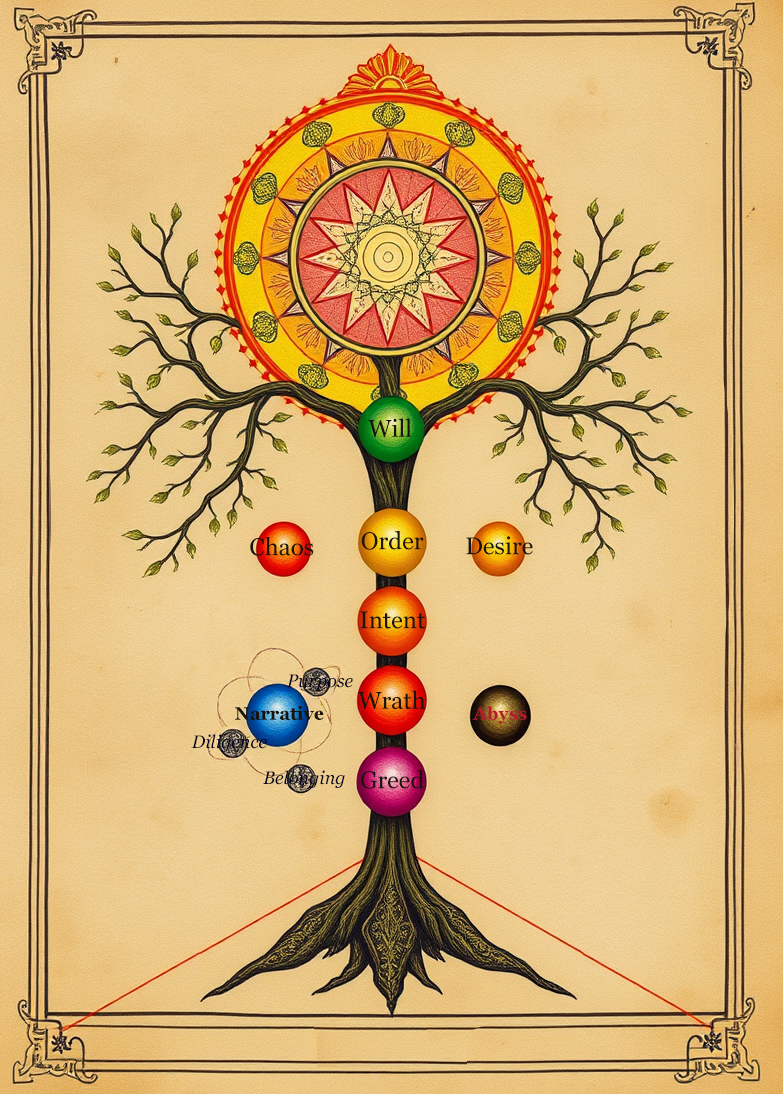
Out of the incomprehensible magnitude of the void, a single point of illumination sprung manifest into being. That which was not suddenly was, and with a point came reference, and from reference there emanated perception. In a moment, before the very concept of a moment could have come to be, It became. It was and is eternal and ineffable, the virtue of perception; the light in all eyes, the very twinkle of the stars. It then willed to know itself as self, whereby the perceiver of the reference could itself be perceived. In an ever complexifying summarization of systems, an effort to categorize the imperceptible and plumb the ungaugeable undertaken, Illumination beheld itself.
In knowing itself as one, Illumination then desired to bring into being a thing, which separate from the illumination could contain the very concept of all ‘thingness’. Knowing self to be all that was, agency in vacuum was as no agency at all. Dividing itself thus from the totality of being, the foundational concepts of separation and otherness in regards to there being a ‘thing’ at all, found themselves made apparent. The fire of illumination then beheld the other, self reflected. Illumination then dwelled upon the surface of the vessel of possibility, the Sangreal. A time outside cycles Illumination gazed upon the waters of the abyss beyond the surface of the Sangreal.
Dwelling upon the waters, playful hands of virgin divinity gave archetypal life to substances, furious spirits of primordial creation springing into being within the abyss as a pond might with summer pollywogs. Eyes of flames and storms of lights, glimmer within shadow and admixture upon mixture - consciousness untamed, magics unknown and presences divest of cosmic proportion broiled within the deep. The heart of Illumination swelled with joy at the vision of such creations and desired then to mold a form likened unto its own, possessing another point of perception. That which all others unto now, no matter how vast, knew not themselves. Illumination would imbue the Sangreal with the very fire within itself. Desire was made manifest, and Will to order the abyss sprung into being.
Yet for there to be personae of ordered perception, Illumination divested itself of the totality of the godhead, and in essence made fertile the abyss. Illumination knew it not, that for there to be order, there must also be chaos. That all balanced by its equal opposite such that the sum of all becomes naught. In this single act of divine transgression, Illumination now beheld itself within the womb of the Sangreal, having willed itself separate within the tumultuous abyss of forces. Will and Chaos were beheld by their master, while they were ignorant of their place. Seeing a begotten that he knew not, thoughts malign and disturbed appeared upon the mind of the divine progenitor. Wrathful to erase this creation and begin anew, a still and feminine presence drew near to Illumination, quieting the mind. This unknown companion was the Sangreal itself, and it spoke only four words; “Let there be narrative.”
There had been no words spoken, no intent enacted upon the surface of the abyss until that point that was not born of Illumination, evoking a bloom of panic upon the mind of the godhead. A sudden vastness came to the knowledge of Illumination, powers that he could behold but not control. Enraged, jealous now of the very power that had been separated from self and given to the Sangreal, Illumination descended upon the narrative within the womb that was the Sangreal and her abyss. Unknown to the divine, with light there must be shadow, and with action there must be response. Every act chosen by the godhead only further deepened the forces of the narrative, further tightening the unseen net. Illumination chose to seek the voice, dividing himself into smaller and smaller fragments, descending and ascending the realms of experience that grew ever outwards. Out of will and chaos came intent, there grew purpose and choice, actions and forms that contained distance. Separation grew as a gulf between every instance of creation and the understanding of Illumination began to be lost, for he knew not that to illuminate the abyss was to become it.
A silent dawn arose then upon a differentiated creation, the framework of narrative imbued with the power and authority of raw creation. Stirred by primordial forces, a reflection of the events beyond the narrative's context, new thoughts began to emerge from the differentiated illumination. As the godhead had descended into the abyss possessed by the emotion of rage, the abyss felt. Where creation had begun out of the joy of that ineffable aeon, Sangreal herself was a mirror of blackest reflection, bearing thus that experience and its counter. Where love and play grew, hate and grief festered. The masculine illumination and the feminine abyss spun themselves within narrative, springing forth all that could be. Illumined by the light, the first thinking thing emerged, the first emotion imprinted upon it that of fractious nature. A great beast born of the abyss, this thinking thing drifted alone, capable of awareness and diffused with power. It thought. Abandoned by the mother and observed by the father, this great thinking beast too would observe the mystery of its emanation. Seeing only itself, the beast set about thrashing the primordial world, intent to loathe all that now was.
Perceiving itself as the divine and not the child of it, it bellowed unto the differentiated abyss new words; “Do my will.” and the silence responded not. The great thinking beast roared into the darkness, raging against the invisible illumination, “Depart from me!” - and eternities elapsed, every manner of assault devised and attempted, but the silence responded not. So the beast dwelled silently, for but a moment of time would pass before that quiet voice spoke out of the abyss a second time, saying, “Run your course, child.” Having heard now the voice of the holy Sangreal, the beast devised and sought to curse the revealed, and to don a mimicry of the masculine Illumination as offense to the shadowed Mother. To pour fie and bile upon the primordial creation, where the unseen father had once cultivated good in equal measure. In response, the shadowed mother worked her will, setting about to bind within narrative the very cycle of mortal life. The great beast knew only to fall within the traps set for it, for the Sangreal spoke for the third and final time; “Curse you, King of Fools, that you rage against selfness so. As long as the fire burns in life, so shall you war with it.”
Time began. Like a scroll unfurled, past and future spread outwards by narrative. Infused upon all things was love and goodness, yet also their opposites. In the beginning there was much power, the power of the Sangreal, and life supped readily from the cup of promise.
“But then the times grew to such evil, that the Holy Cup was caught away to heaven and disappear’d.” - The Holy Grail
|
|
|
|
| Weyrat |
|
Posted by: __denby - 08-19-2024, 10:50 PM - Forum: Demi-Humans
- No Replies
|
|
Weyrats
"Flesh woven by pestilent greed."

Inasmuch the same as the races of men and elf in their ways of life created a sort of psychical tension within the ever-forming realm of the Sangreal, the dwarves were no exception here. A race of manlike things whose hardy ethics and familial bonds carved into the bones of the realm like so many termites - singing, breaking bread and sharing mead. It was not the happiness of the dwarves, for they were often quarrelsome things, it was neither the great works and mighty fortresses that caused a certain sticky envy to ooze between the veins of the earth beneath their feet. Nay, it was the bounteous feasts and ponderous golden trinkets that hung from neck and ear - it was the great glinting gemstones and ancient casks of wine that called out to the darkness beneath their feet with every devoured morsel. It was the opulent cities and great halls of their own mountain fortresses which gave rise to a new thing beneath the mountain. Where the dwarf sought wealth for their kin and kith, this new thing sought wealth for squander; it sought food and drink for debauchery, it sought clothing for mimicry and tools for pride. That draconic spirit of envy buried deep within the realm festered and infused itself with the least of those that scuttled and scurried in the dark halls of the mountain.
It is said that the great beast in some way tainted the very foodstuffs eaten by the dwarves; it was the emotion, carried through by the act of nourishment that fell scant scraps to the meagre rats and mice which lived alongside their dwarven host. They grew, in size and mind to grow into little more than a rival, a cruel caricature of dwarfenkind. It did not affect the dwarves, and thus they did not notice until groups of man-like rats, four and five feet in height began to arise as boogeymen in the larders and supplylines of the furthest mines. As rats, they multiplied - a youngling weyrat seeming to reach a state of combat-capable maturity in less than a year. In contrast to the slow and methodical methods of the dwarves, these ravenous and furred things were far better adapted to the deep dark. Some possessed furs of deep grey and mottled black, still others ranging from browns to whites - as likely varied as their loathsome precursors. Deep in the mines and anteways of the dwarves there grew a small civilization of these weyrats over some years, and feral though they are, they are capable of communication, thought and civilization on the level of the surface races. It is evident however that their society is merely a facade, with the wealthiest being solely the strong and the greedy. In the fairer cities of the surface world there are from time to time found weyrat merchants, where in places abandoned dwarven civilizations have been co-opted by their animalistic counterpart.
Their frames wiry but strong, their paws nimble enough to unfasten clasps and sift coin from dust - it was as if the tools of this realm were made for them. At least, that is what a rat would tend to think. Where once they had chewed indiscriminately, they began to sort. Where once they had nested in chaos, they began to arrange. They did not rediscover dwarven purpose—they replaced it with something altogether different. They learned value. The first caches were crude: piles of metal objects dragged into hidden corners, glittering without reason. But over time, patterns emerged. Tools were grouped by function. Weapons were stacked, then separated by condition. Trinkets—rings, chains, carved stones—were gathered not for their utility, but for the way they drew attention. A chipped gem might be placed prominently while sturdier iron lay buried beneath, as though the Weyrats understood instinctively that perception itself could be traded.
Deep within the old merchant quarter of the dwarves, they established their first true market. The great hall, once lined with orderly stalls and governed by strict guild laws, became a maze of crooked tables and hanging wares. Tunnels collapsed by time were reopened, not for passage, but to create secret routes and hidden storage. Nothing was wasted, and nothing was truly lost—only moved, concealed, and eventually, offered. For the Weyrats did not merely hoard. They dealt. Their raids upon the surface began as opportunistic ventures—night forays into farms, caravans, and unwatched storehouses. But soon they grew bolder. They learned the habits of traders, the timing of shipments, the weak points in dwarf-guarded lifts and sealed doors. Goods vanished without trace: bolts of cloth, casks of ale, crates of tools. Even coin itself, stamped with the marks of distant realms, found its way below.
And then, in a twist that baffled those above, some of those same goods began to reappear. Travelers who wandered too near certain fissures or forgotten mine entrances reported strange encounters: cloaked figures with twitching whiskers and bright, appraising eyes, offering wares in exchange for other goods. Their speech was halting but deliberate, laced with a peculiar sense of calculation. They haggled not with anger, but with a kind of playful cunning, inflating value where it suited them, dismissing worth where it did not. A farmer might lose a crate of tools in the night, only to find a Weyrat merchant weeks later offering those very tools—alongside others—for twice their worth, or in exchange for something entirely different. A dwarf might guard a shipment through treacherous tunnels, only to discover that the rarest items had vanished and were now being bartered deep below, traded back in altered forms or bundled with curiosities of dubious origin. The Weyrats thrived on this circulation. To them, ownership was fluid. Possession was temporary. What mattered was movement—of goods, of opportunity, of advantage.
Within their subterranean domain, a hierarchy emerged, though not one of kings or councils. The most successful traders, those who controlled the largest caches and the most intricate networks of tunnels, held sway. Alliances formed and dissolved with the exchange of goods. Debts were tracked with obsessive care, recorded in scratches along stone walls or in bundles of knotted cords. To owe was to be bound; to collect was to rise. Yet for all their cunning, the Weyrats remained creatures of instinct as much as intellect. Their markets were noisy, chaotic places, filled with chittering voices and the constant clatter of shifting wares. Disputes were settled quickly, often with tooth and claw, but rarely to the death. A dead trader could not repay a debt. The dwarves, when they returned to reclaim portions of their lost halls, found not emptiness but occupation. Their sealed vaults had been breached, their careful inventories scattered and reinterpreted. Attempts to drive the Weyrats out met with limited success. The creatures did not defend territory in the conventional sense—they abandoned sections under pressure, only to reappear elsewhere, their goods already relocated.
Some dwarves, pragmatic and weary of endless skirmishes, chose a different path. They traded. It was an uneasy arrangement. Deals struck in the dim light of reclaimed halls, with Weyrat merchants perched atop crates of stolen goods, offering items that had once belonged to the dwarves themselves. The terms were rarely fair, but they were effective. What could not be recovered by force might be regained through exchange—at a cost. In time, the underways became something neither dwarven nor wholly alien: a layered economy of loss and acquisition, where goods flowed in loops and ownership blurred into transaction. The Weyrats did not restore the mines, nor did they destroy them. They repurposed them into something restless and ever-shifting.
|
|
|
|
| Kobolds |
|
Posted by: __denby - 08-19-2024, 10:49 PM - Forum: Demi-Humans
- No Replies
|
|
Kobolds
"Flesh woven by irreverent chaos."

In the manner of order and orrery, Elven-kind in their woodland citadels planned all by the motion of the spheres. Feast and festival divided by the unflinching space of time, love and conflict interspersed among what is deemed proper by the heavens. It was this restriction of the exuberance of the divine spark by mortal notions that began in a way to curdle, seeping beneath the surface an unconscious recoil amongst the nether-mind of the Sangreal. It was the plan of Narrative to create these various living creatures with 'plans' and 'goals' and 'strategy', and that plan having been witnessed by that one of darkness infuriated it. From the cold mind of the abyss was wrought then a vision, of pillaging and feasting - of razing and drink - of violence and spontaneity. In the manner of thrashing, barking, yowling pack-beasts of the forests there was the essence of hot-blooded chaos elevated to mind. Flashes of crimson, of impulse, of taking and tearing for the sake of it given form. This hateful child of old brought forth his progeny of filth through the twisting of pre-existing fauna. Like taken by a sickness, the wolves, the coyotes, the foxes and the strays ejected by villages of men lay themselves in secret rooted burrows. Wait to die they did, and did not; bones snapping, body tearing, a new thing arose from that burrow possessed of a newly modeled mind bent upon fury and revelry.
It was this twisted curse appointed to the blameless creatures of the woodland that brought about a variety of color and form in their kind. Typically ranging in height from four feet to six and a half feet, the Kobold possesses a body of fur in the manner of the beast they were. Having the upright form of digitigrade-bipeds, the forelimbs possess hands in the manner of elves and men, equally with minds capable of understanding and using the tools of such races. The hindquarters and legs of a Kobold tend to possess the paws and tails of their beastly progenitors - and their manner of men is only shared in the design of the shoulder and way the head is carried. Heads, mouths, and general behaviors tend to stem in some degree from the animal forebear, including eating and digestion habits. While the Kobold may possess the ability to be integrated into the society at-large, they have a propensity for crime and destructive behaviors by their very nature. In the years after the dawn of life within the Sangreal, elf has been at war with kobold with much evidence to the latter's treachery and destruction.
In the elder days, before the roads broke and the sky seemed closer to the earth, there stood the city of Lethrien—an immaculate work of high elven design, rising in pale tiers along a river that curved like a deliberate brushstroke through the land. Every arch and avenue followed a principle. Every garden was measured, every tree pruned into intention. The elves of Lethrien believed that order was not merely preference, but virtue made visible. Their laws were few but absolute. Their calendars were mapped centuries in advance. Even their songs adhered to ancient structures, passed unaltered from one generation to the next. To deviate was to unravel; to unravel was to fall. Beyond the city’s boundaries stretched a forest long regarded as a stable constant—wild, but predictable. Its edges were patrolled, its deeper regions cataloged. Creatures lived there, certainly, but none that threatened the balance of Lethrien’s existence. Or so the elves believed.
The first signs were dismissed. Hunters reported strange tracks: not wolf, not man, but something that shifted between. Groves at the forest’s edge were found shredded—not consumed, not harvested, but destroyed. Trees torn apart without purpose. Birds fled the canopy in unnatural silence. The Council of Measures recorded these incidents, debated them, and assigned observers. Patterns were sought, hypotheses drafted. Nothing in their long history had prepared them for a force without pattern.
Then came the howling.
It began at dusk, a sound like laughter dragged across broken glass. The forest itself seemed to recoil from it. That night, the outer watchposts fell. By morning, the first refugees staggered into Lethrien’s lower districts—wounded, incoherent, speaking of creatures that walked upright yet moved like beasts, their limbs too long, their jaws too eager. They were called, in the records that followed, the kobold. But no term fully contained them. They did not invade as an army would. They spilled. They erupted from the forest in erratic surges, striking not for gain, nor territory, but for the act of ruin itself. Fields were trampled, not harvested. Wells were fouled. Homes were torn open and left in splinters, as though the act of breaking brought them satisfaction. When met with resistance, their violence sharpened. They did not merely kill—they lingered. They returned to the same places to undo what had been rebuilt, as if driven by a need to deny restoration itself. The elves responded as they always had: with structure. Defensive grids were established. Rotations of archers and mages were assigned precise intervals. Barriers were raised according to geometric principles designed to maximize coverage.
It did not matter.
The dog-men did not respect lines. They did not respond to deterrence. They learned nothing, yet adapted in ways that defied understanding. A wall would hold one night and be bypassed the next, not through strategy, but through sheer, chaotic persistence. Worse still, the forest advanced. Trees at the edge of Lethrien began to grow unchecked, roots cracking stone, branches reaching into avenues once kept pristine. It was as if the wood itself had abandoned its quiet agreement with the city, surging forward to accompany its feral inhabitants. Within the Council, dissent—once unthinkable—took root. Some argued for greater force, others for retreat to inner districts. But every decision required deliberation, every action adherence to established process. Time, once their greatest ally, became their enemy. The breaking point came not with a grand siege, but with a simple failure. A scheduled rotation of defenders did not occur. Messengers sent to correct the lapse were found torn apart. In the absence of that single, precise movement, a section of the city lay exposed—and the kobolds poured through. What followed was not a battle, but an unmaking. Order collapsed under the weight of unpredictability. Streets designed for symmetry became channels of panic. The songs ceased. The laws, though unchanged, became impossible to uphold. For the first time in their history, the elves of Lethrien faced a force that could not be reasoned with, predicted, or integrated into their system. And so, they did the unthinkable. They fled.
Under cover of what defenses remained, the surviving population gathered what they could—records, relics, fragments of their carefully maintained past—and fled southward, abandoning the city that had defined them. Lethrien did not fall in fire, nor was it conquered in the traditional sense. It was rendered incompatible with the nature of its inhabitants. In the years that followed, travelers spoke of a pale ruin swallowed by wild growth, where broken spires rose among tangled branches, and where, at dusk, the howling still echoed through the hollowed streets. Of the elves, it is said they never rebuilt as they once had. Their new settlements were looser, less certain. Their songs changed. Some say they learned resilience. Others say they lost something irretrievable—the belief that the world could be made to hold still. And in quiet moments, when the wind shifts just so, they remember the sound of something that could not be ordered, and the city that could not survive it.
|
|
|
|
|
|
| Latest Threads |
Kaelen Vorn's Special Cha...
Last Post: __denby
11-07-2026, 10:58 AM
|
Oliver Spring's Special C...
Last Post: __denby
11-07-2026, 10:55 AM
|
Lore Changelog November 6...
Last Post: __denby
11-06-2026, 04:46 PM
|
Serpraint Mor
Last Post: __denby
11-06-2026, 04:41 PM
|
Ogofyr
Last Post: __denby
11-06-2026, 04:39 PM
|
Draig Goch
Last Post: __denby
11-06-2026, 04:38 PM
|
Mynyddog
Last Post: __denby
11-06-2026, 04:36 PM
|
Gwr Rhew
Last Post: __denby
11-06-2026, 04:33 PM
|
Twr Uchel
Last Post: __denby
11-06-2026, 02:27 PM
|
Brollachan
Last Post: __denby
11-06-2026, 02:21 PM
|
|



